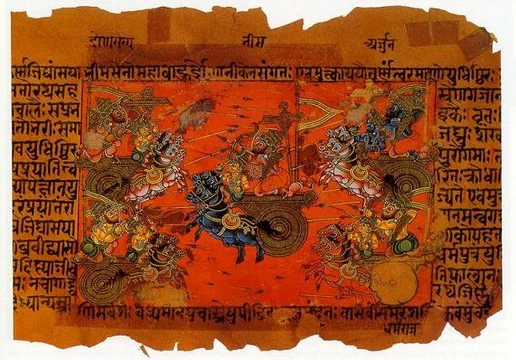
Hindu mythological wars
Wars between devas and asuras, described in Hindu texts.
In the ancient Hindu texts of India, mythological wars involve both mortal heroes and divine or supernatural beings, who often wield immensely powerful supernatural weapons. According to Hindu teachings, war is a last resort, to be undertaken only when all peaceful options have been tried. Fighting in a righteous war, known as dharmayuddha, was considered honorable and a key duty of the Kshatriya, or warrior class; victory in such conflicts was seen as a point of honor.
In Vedic literature, the most important battle is between the god Indra and the demon Vritra. Indra’s defeat of Vritra frees the rivers, cattle, and Ushas, the goddess of dawn.
The Kshatriya class performed several war-related sacrifices. The Ashvamedha, or horse sacrifice, involved letting a horse roam freely for a set period; the king performing the ritual claimed all the lands the horse touched. Any king whose authority was challenged had to either prove himself in battle or accept the challenger’s supremacy. If the horse returned safely, the main sacrifice was performed, and a successful king was crowned Emperor of the World. This ritual allowed peace if no king contested the horse. The Rajasuya was considered the ultimate sacrifice: the king openly challenged every ruler in the world to accept his supremacy or defeat him in battle. If he returned victorious over all known rulers, the sacrifice would grant him a place in Indra’s abode after death. The Vishvajit Yagna was a sacrifice performed by Brahmins after a king had won a war.
In Puranic literature, the ongoing war between the devas and asuras is fought for control of the three worlds: Svarga (heaven), Bhumi (earth), and Patala (the underworld). Both groups are technically equal, possessing great religious and martial powers, but the devas are devoted to the Supreme Being and virtue, while the asuras grow increasingly atheistic and deceitful over time. This divide is greatest in the Kali Yuga, the final age.
The Brahmanda Purana describes twelve battles between devas and asuras in the Varaha kalpa. These include Narasimha versus Hiranyakashipu; Vamana versus Mahabali; Varaha versus Hiranyaksha; the churning of the ocean (Samudra Manthana); the Tarakamaya War between Soma and Brihaspati; the Adibaka conflict, where the sages Vishvamitra and Vashishta were cursed to become a crane and a myna bird, respectively, and fought daily unt
- Primary source texts
- Vedas, Puranas, Ramayana, Mahabharata
- Key divine participants
- Indra, Vishnu, Shiva, Devi, Devas, Asuras
- Notable war sacrifices
- Ashvamedha, Rajasuya, Vishvajit Yagna
- Prophesied final avatar
- Kalki (appears at end of Kali Yuga)
- Famous formation
- Chakra Vyuha (wheel formation)
Lore & Background
The central battle in the Vedas is between Indra and Vritra, and the defeat of the demon Vritra leads to the liberation of rivers, cattle and Ushas (dawn/light). In Puranic literature, the perennial battle between the devas and asuras is undertaken over the dominion of the three worlds: Svarga, Bhumi, and Patala. Both races are technically equal, possessors of great religious and martial powers, but the devas are committed to the worship of the Supreme Being and the practice of virtue, while the asuras have atheistic and devious tendencies that grow over time. The divide is the greatest in the Kali Yuga, the final age.
In the Varaha kalpa, twelve battles between the devas and the asuras are described in the Brahmanda Purana, including Narasimha and Hiranyakashipu, Vamana and Mahabali, Varaha and Hiranyaksha, Samudra Manthana, Tarakamaya War, Traipura, Andhakara, Dhvaja, Varta, Halahala, and Kolahala. The Ramayana features the warrior Rama, the 7th Avatar of Lord Vishnu, who single-handedly slayed the 14,000 demon hordes of Khara, and is responsible for the ultimate killing of Ravana. Various military formations, or vyuha, are described, such as the Chakra Vyuha, Padma Vyuha, and Krauncha Vyuha.
Reader's Guide
Hindu mythological wars serve as a framework for understanding cosmic order, duty, and the balance between good and evil in Hindu cosmology. The wars are not merely historical or legendary conflicts but are deeply embedded in religious and philosophical teachings. The concept of dharmayuddha, or righteous war, establishes that war is a last resort and that participation in such a war is honorable, especially for the Kshatriya class. The perennial Devasura War symbolizes the ongoing struggle between virtue and vice, with the devas representing piety and the asuras representing atheism and deceit.
The war sacrifices, such as the Ashvamedha and Rajasuya, were rituals that allowed kings to assert dominance and achieve imperial or heavenly rewards, but they also provided opportunities for peace if other kings chose not to contest. The prophesied end of the world at the conclusion of the Kali Yuga, with Kalki waging the final battle, underscores the cyclical nature of time and the eventual triumph of good. The detailed descriptions of battle formations, such as the Chakra Vyuha, and the feats of heroes like Rama and Hanuman, have influenced later literature, art, and cultural narratives, reinforcing ideals of courage, loyalty, and divine intervention.
Did You Know?
- The central battle in the Vedas is between Indra and Vritra, leading to the liberation of rivers, cattle, and Ushas.
- In the Varaha kalpa, twelve battles between devas and asuras are described in the Brahmanda Purana.
- Abhimanyu learned how to break into the Chakra Vyuha formation while in the womb of Subhadra, but not how to break out.
- King Sagara successfully performed the Ashvamedha sacrifice 99 times, but failed on the 100th due to Indra's plot.
More in War in mythology 1-20
Spotted an error? Know more?
This is a living reference — every entry is fact-audited, and reader corrections feed straight into our audit queue. Suggest an edit · See this site's audit record