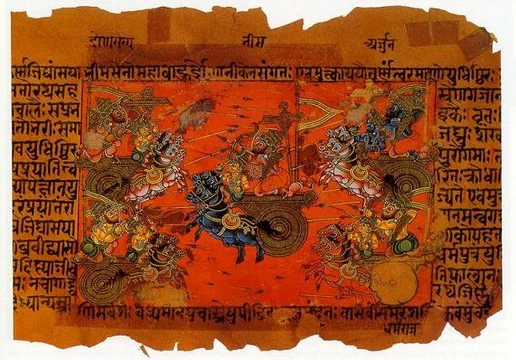
Kurukshetra War
Epic war from the Mahabharata, context for the Bhagavad Gita.
The Kurukshetra War, also called the Mahabharata War, is a war described in the Hindu epic poem Mahabharata. It arose from a dynastic struggle between two groups of cousins, the Kauravas and the Pandavas, for the throne of Hastinapura. The war serves as the context for the dialogues of the Bhagavad Gita.
- Also known as
- Mahabharata War
- Setting
- Kurukshetra (field of the Kurus), also called Dharmakshetra
- Primary combatants
- Kauravas and Pandavas
- Key figures
- Krishna (mediator and charioteer), Arjuna, Bhishma, Drona, Karna, Shalya, Drupada, Shikhandi
- Textual source
- Mahabharata (primarily books 6–10)
- Historicity
- Subject of scholarly discussion; possible historical core c. 1000 BCE or later
Lore & Background
The Mahabharata recounts the lives of the Kuru clan, focusing on a dynastic conflict between the five Pandava brothers and their hundred Kaurava cousins. The climactic battle takes place at Kurukshetra, chosen because sins committed there would be absolved due to the land's sanctity. The war narrative occupies nearly one-fifth of the epic, primarily in its sixth to tenth books. Krishna plays a pivotal role as mediator and as Arjuna's charioteer; on the eve of battle, when Arjuna hesitates to fight his relatives and teachers, Krishna delivers a discourse on duty and existence, later compiled as the Bhagavad Gita.
Reader's Guide
The historicity of the Kurukshetra War remains the subject of scholarly discussion. The Battle of the Ten Kings, mentioned in the Rigveda, may have formed the core of the story, but the war was greatly expanded and modified in the Mahabharata, making its accuracy dubious. Attempts have been made to assign a historical date, with research suggesting c. 1000 BCE, while popular tradition claims the war marks the transition to the Kali Yuga, dating it to c. 3102 BCE. British Indologist A. L. Basham concluded that a great battle at Kurukshetra, magnified to titanic proportions, formed the basis of the epic. The war is not mentioned in Vedic literature, and its prominence in later literature led to various scholarly estimates ranging from the ninth century BCE to c. 750–350 BCE. The existing text of the Mahabharata mostly belongs to the period between c. 500 BCE and 400 CE. Despite inconclusive data, the war's narrative has had a lasting cultural and religious impact, particularly through the Bhagavad Gita.
Did You Know?
- The war is used as the context for the dialogues of the Bhagavad Gita.
- The site was chosen because sins committed there would be absolved due to the land’s sanctity.
- The war narrative occupies nearly one-fifth of the Mahabharata.
- Popular tradition dates the war to c. 3102 BCE, marking the transition to the Kali Yuga.
More in War in mythology 1-20
Spotted an error? Know more?
This is a living reference — every entry is fact-audited, and reader corrections feed straight into our audit queue. Suggest an edit · See this site's audit record